Walmart Pickup and Delivery Substitutions: How to Stay in Control
An out-of-stock product can change more than the brand in your Walmart grocery order. A replacement may cost more, contain a different quantity or fail to do the…
In this guide
An out-of-stock product can change more than the brand in your Walmart grocery order. A replacement may cost more, contain a different quantity or fail to do the job you planned. The useful approach is to decide which substitutions are acceptable before shopping starts, then check any proposed change against the product you actually need.
The quick takeaway: Set item-level preferences, watch for substitution messages and compare the replacement’s complete price and specification. Reconcile the final receipt separately from any pending payment hold.
Decide where flexibility is useful
This guide concerns Walmart.com’s US store pickup and delivery orders. Do not assume that shipped Marketplace orders or Walmart services in another country follow the same process.
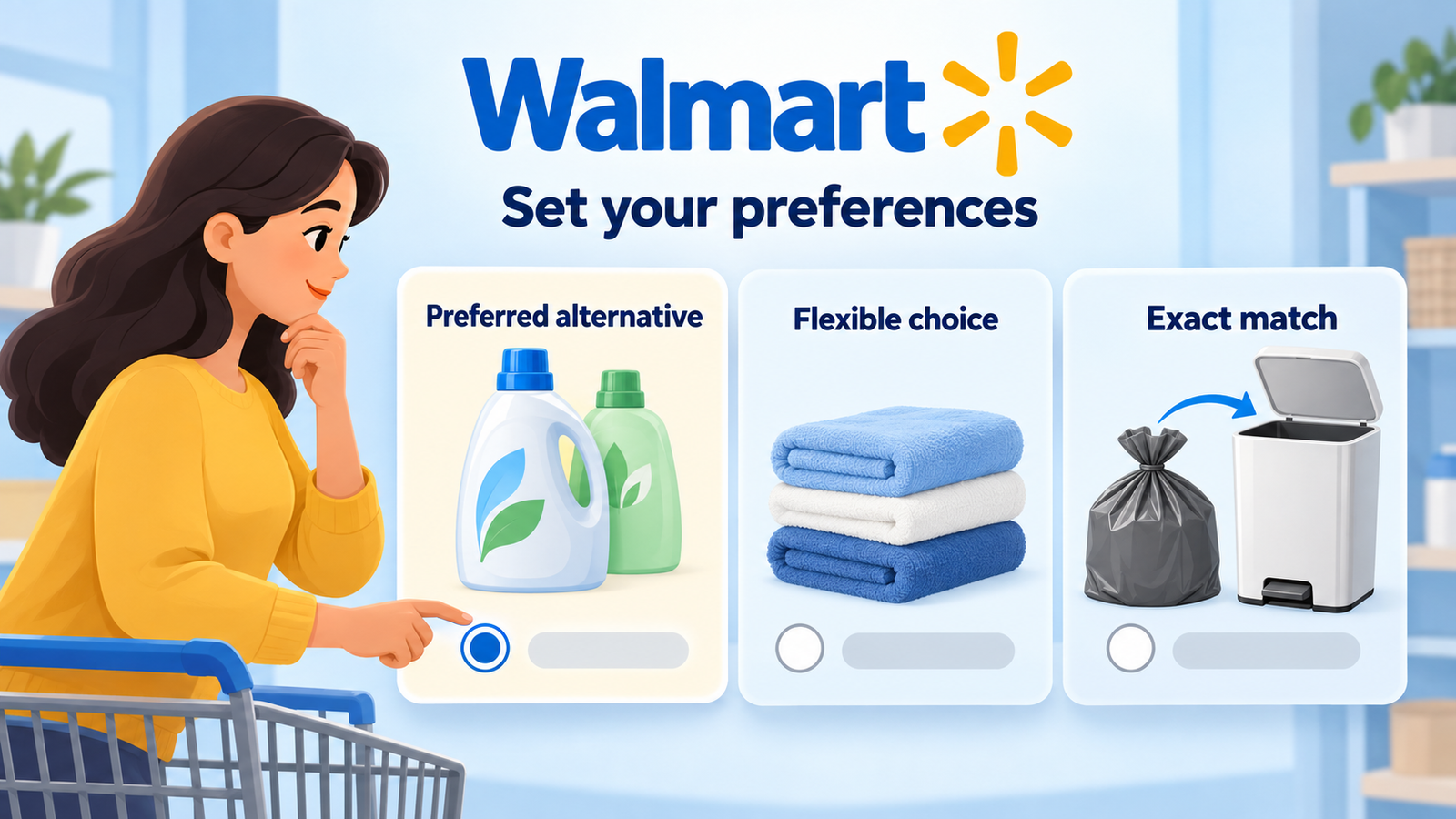
Before checkout, divide the basket into flexible items and exact-match items. You might accept another brand of plain storage bags but need a particular size of bin liner for the container you own. The right boundary depends on the item’s purpose, not just its place in the grocery aisle.
Walmart’s substitution instructions let you choose preferred alternatives or mark items you do not want replaced before ordering. If an unavailable item has substitutions disabled, it is removed from the order.
A specific preferred alternative is more useful than hoping a broad similarity will be enough. Compare count, dimensions, flavour or formulation as appropriate. For a product with an ingredient restriction, check the replacement’s actual label; a similar package or product name does not establish suitability.
Sometimes no replacement is the better choice. An empty place in the order is inconvenient, but paying for something you cannot use can create a second problem. Identify essential items early enough to have a separate backup plan.

Read the replacement as a different purchase
Walmart charges the substituted item’s price. Compare both total cost and usable quantity before accepting it.
A replacement can be cheaper per unit while requiring a larger payment today. It can also cost more per unit while looking cheaper because the pack is smaller. Neither observation settles the choice without knowing how much you need and can store.
Apply the same check to a smaller pack: does it cover the planned meal, cleaning task or household need? If you would immediately need another purchase, count that additional trip or order when judging the apparent saving.
Our Walmart complete-price comparison guide covers the broader listing comparison. For a substitution, repeat the check on the actual replacement rather than inheriting your decision about the unavailable item.

Use the response window in the order message
Walmart sends a substitution email with a limited response window. Its help page says an unanswered offer can be substituted. Read the deadline in your own message instead of assuming that silence rejects it.
During the order window, check the contact channel associated with the purchase. A message may need attention while you are doing something else, so choose an order time when you can reasonably review changes. Do not rely on a notification sound alone.
For each proposal, check three things in order: whether it does the required job, whether the quantity works and whether the amount fits your budget. This sequence prevents a low price from distracting you from an unusable substitute.
Keep the decision clear. If a proposed replacement is unsuitable, decline it through the available order control. Save the confirmation or order update so that a later receipt can be checked against what you actually accepted.
If the product is essential and no substitute works, make a backup decision for that product. Avoid adding unrelated groceries elsewhere simply to turn the inconvenience into another large basket.
Check what arrived and use the right correction route
At pickup, Walmart says you can tell the store associate that you do not want a substitution and have it removed. For delivery, the driver cannot remove it and return it to the store; use the return process in Purchase History instead.
Before putting purchases away, match the substituted products with the final receipt and any acceptance records. Look at the exact count, size and variant, not only whether a familiar brand arrived. Distinguish an unwanted substitute from a missing product or an item charged at an unexpected amount; those are different support questions.
A useful report identifies the order, original product, replacement received and specific mismatch. For example, explain that the replacement’s dimensions do not fit the container, or that the receipt still includes a substitution you declined. Keep relevant packaging and order records while the issue is being reviewed.
Payment method can matter. SNAP/EBT orders have additional substitution and backup-payment rules on Walmart’s help page. Read that part of the policy when it applies rather than using an ordinary card-payment example as a universal rule.

Separate the receipt from a pending payment hold
A pending bank entry is not necessarily the final price of your replacement. Walmart’s temporary holds guidance explains that an estimated authorization can differ from the final charge because of substitutions, weighted items and other adjustments. The bank controls release of the hold.
Use the final receipt to investigate the order calculation. List the original products, removed items, accepted replacements and any other charges shown. Then identify whether the bank entry is pending or completed. That gives you a clearer question than describing every difference as an overcharge.
If the final receipt has an unexplained product charge, contact Walmart with the order details. If the question is a pending hold’s release, ask the bank using the transaction information. Keep the two issues separate even when they appear at the same time.
A practical substitution checklist
- Mark exact-match products and decide where substitutions are acceptable.
- Check a preferred alternative’s specification before ordering.
- Review messages within the deadline shown for your order.
- Compare total price, usable quantity and practical suitability.
- Match what arrived to the final receipt and any recorded decisions.
- Identify pending holds separately from completed charges.
The aim is an order that still meets your needs when one product disappears from the shelf. A successful replacement preserves the purpose of the purchase as well as keeping its cost understandable.
Common questions
Is the cheapest replacement always the best choice?
No. Compare what it can actually do, the usable quantity and whether a second purchase would be needed. A lower total for an unsuitable product is not useful value.
Should I accept a larger pack with a lower unit price?
Only if the extra quantity is useful and the higher total fits your budget. Check storage and likely use before treating a bulk replacement as a saving.
Can I use the original product’s details to judge the replacement?
Use the replacement’s own specification, packaging and label. Similar products can differ in count, dimensions or formulation, even when their photographs look alike.